Bienvenue au "French in Action"
Welcome to "French in Action" - An Immersive Course in French Language and Culture
French in Action is a landmark instructional video series designed to develop French speaking and listening skills. Unlike traditional language courses, it utilizes a unique “immersion” method that transports learners directly into the culture and rhythm of life in France.
Created by Professor Pierre Capretz, the series was designed to provide a comprehensive, cinematic approach to language acquisition. It consists of an introduction and 52 full-length episodes (~28 minutes each) and remains one of the most respected educational resources for French language learners worldwide.
For years, French in Action was available as a free resource through Annenberg Learner (learner.org). Given the discontinuation of the Annenberg Learner site in July 2026, this site was established to ensure the videos and associated resources remain accessible to all interested learners.
This site provides the necessary resources for your study of French through the French in Action series. Enjoy the journey!
Visit Le Café
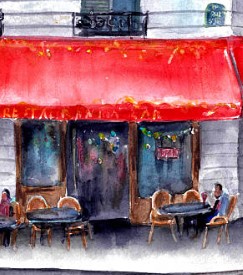
The French café is a traditional gathering place to socialize and discuss the issues of the day. Visit to post comments, offer suggestions, or ask questions.
FiA Site Status
Ongoing activities (thru 7/8)
Upgraded text from 1987 to 3rd edition (complete).
Upgraded Workbook Part 1 from 2nd to 3rd edition (complete).
Near future: Add student and instructor test banks (if vendor ever ships them).
Adventures in Paris and the French Countryside
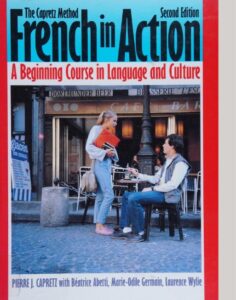
French in Action follows the story of Robert, an American student in Paris, who becomes fascinated with a young French woman named Mireille after seeing her photograph by chance. His search for her leads him through cafés, apartments, classrooms, train stations, and cities across France, where their growing relationship becomes the thread connecting a fully immersive introduction to French language and culture. Along the way, the series blends romance, humor, misunderstandings, friendships, family encounters, and everyday life into a kind of educational road movie — teaching viewers French not through translation, but by letting them experience the language inside the characters’ world.
Getting Started
Essential Resources and Learning Strategies
Watch the preview episode presented by Professor Pierre Capretz of Yale University to understand his language teaching philosophy and his approach to creating this immersion-based French language course.
Essential resources: Read strategies for maximizing the learning process and read and/or print essential “global resources” including text and workbook frontmatter and appendices.
Part 1
Foundations
Épisodes 1 à 8
We meet Robert Taylor, an American student arriving in Paris, and Mireille Belleau, the vibrant, witty French woman he encounters. This part captures the initial “culture shock” and the spark of their burgeoning, often humorous connection. Core characters are introduced amid the immersive world of Paris. You will learn the basics of introductions, greetings, and describing people and places.
Key Concepts: Subject pronouns, gender and number agreement, the verbs être and aller, and expressing immediate future/intent.
Part 2
Navigating Paris
Épisodes 9 à 18
The narrative expands to include social encounters and professional settings. As Robert and Mireille spend more time together, their social circles overlap. You are introduced to the wider web of Mireille’s family and friends, shifting the story from a simple “tourist encounter” to a complex set of social dynamics. You will focus on describing others in detail and navigating basic work-related vocabulary.
Key Concepts: Possessive and demonstrative adjectives, stressed pronouns, savoir vs. connaître, and reflexive verbs.
Part 3
Education & Food and Drink
Épisodes 19 à 26
Mireille and Robert’s story deepens through academic and social life. The relationship faces the realities of daily life—university pressure, dining, and the challenges of communication. The characters are no longer just “getting by”; they are integrating into the fabric of French society. This part centers on the vocabulary of the university environment, food, and dining.
Key Concepts: Past tenses (imparfait), interrogative pronouns, direct/indirect object pronouns, and nuances of giving commands and expressing necessity.
Part 4
Travel & Regional Exploration
Épisodes 27 à 35
The setting widens. The characters leave the city, moving through different French landscapes. This tests their relationship in new environments, highlighting how language is a tool for navigation—both physical and metaphorical. The series moves into practical travel scenarios and the domestic sphere. You will learn how to navigate public transportation and discuss living environments.
Key Grammar: Prepositions of place, movement verbs (aller/venir), the partitive articles for food/quantity, and expressing approval or disapproval.
Part 5
Entertaining & Money
Épisodes 36 à 45
Life in Paris isn’t all romance; this part deals with the practical side of existence. Robert and Mireille navigate entertainment, commerce, and money. Tensions and misunderstandings arise, mirroring the complexity of the language they are mastering. Explore the vibrant world of Parisian entertainment and the realities of getting and spending. This part covers hobbies, shopping, and economic social interactions.
Key Grammar: Advanced verb structures (pouvoir/vouloir), negation variations (ne…plus), and sophisticated descriptions of time, centuries, and currency.
Part 6
Geography & Tourism
Épisodes 46 à 52
In this grand finale, the characters reflect on their growth. Geography and tourism serve as the backdrop for the final resolutions of the story, showing how much Robert has transformed from the outsider of Part 1 to a true participant in French life. The story expands across French geography and tourism. You will synthesize the entire course’s learning to handle complex travel discussions and look back on the journey.
Key Grammar: Complex historical narration, synthesis of all verb tenses, and mastering the “culture with a small c”—the attitudes and behaviors that make the language truly come alive.
Using the Resources
For each episode, you will find the following associated resources. The text and workbook provide useful exercises. The study guide offers a more detailed discussion of key grammatical concepts.
📺 Full Video Series
High-quality streaming of the entire mystery, from Spain to Mexico, with accessible closed captioning.📚 Instructional Material
Episode-specific resources useful for homework assignments, class discussion, and individual comprehension practice, including:
- Vocabulary
- Useful expressions
- Questions (and answers) organized into topic-related groups.
📚 Print Resources (in digital format)
- Textbook: Lessons and activities to prepare for watching and then reviewing episode comprehension.
- Study Guide: Very useful resource focused on French grammatical concepts & details.
- Workbook: Extensive lessons and activities to reinforce grammar concepts and vocabulary.
- Workbook Audio files: A complete set of workbook audio files is included for each episode.
- Instructor’s Guide for each episode.
- Episode transcripts: The transcripts were generated initially using Riverside Transcription software and then cleaned and improved using AI tools.
Interested in learning Spanish?